Credentialing software built for your medical practice.
If your credentialing currently lives on a spreadsheet, in your office manager's head, or in a tool that wasn't built for primary source verification with Agentic AI, you're paying the cost of legacy software without getting the benefit. Evercred fixes that without the implementation project.
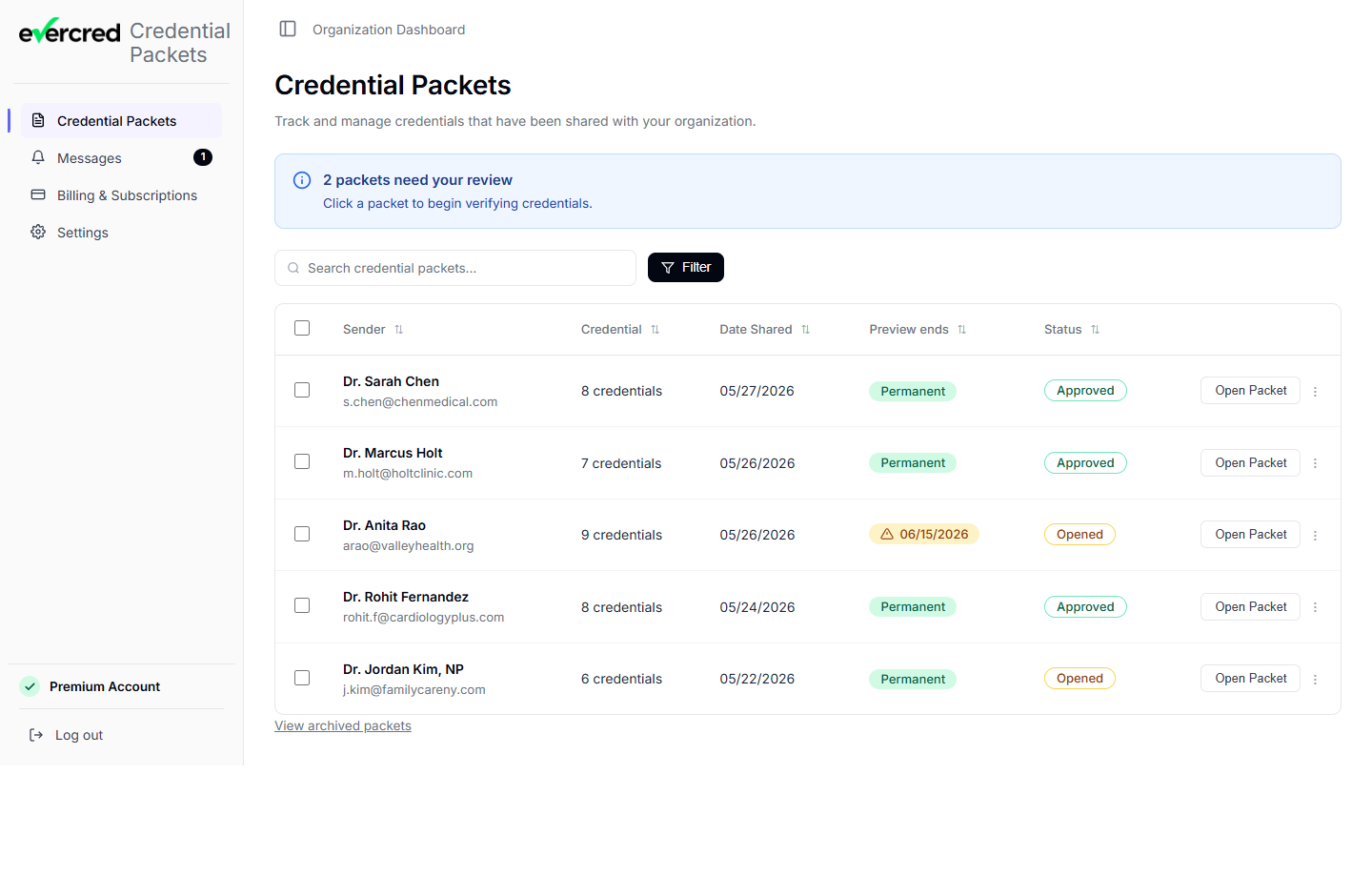
The dashboard your team runs from.
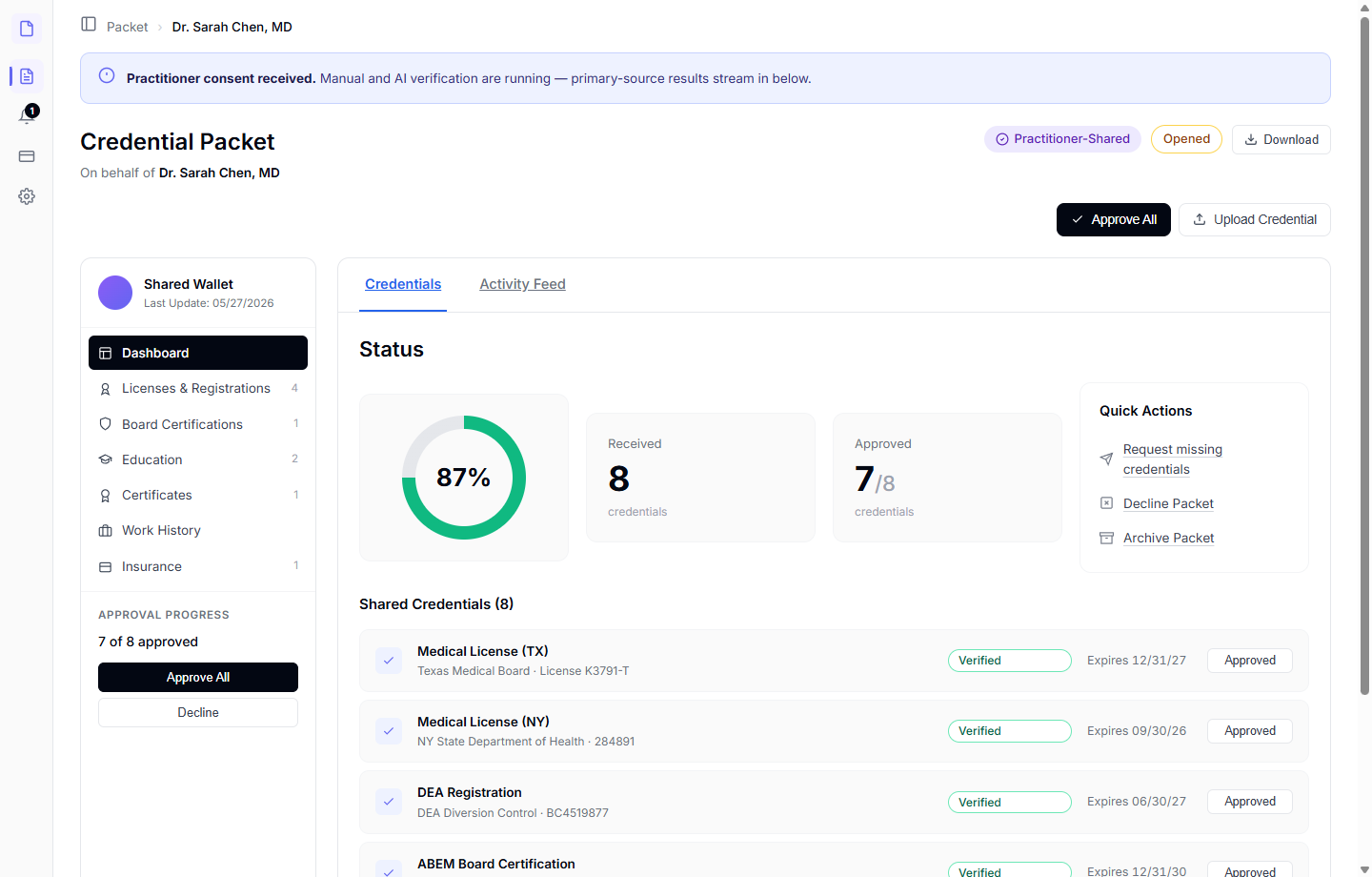
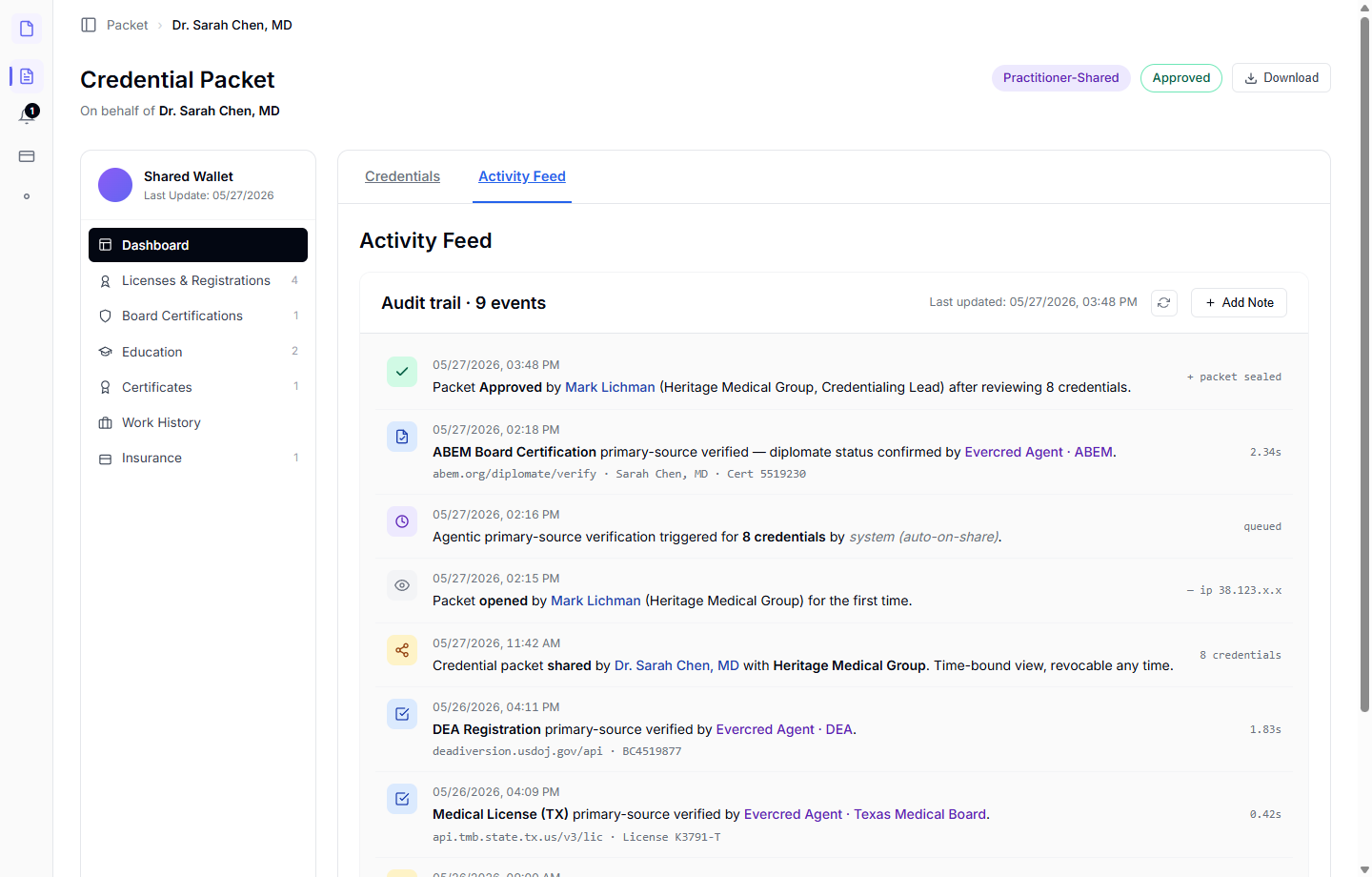
One queue of incoming credential packets. Per-packet primary-source verification, approval workflows, audit trail. No procurement project to install.
Calculate your savings.
The math is simple, it's brutal.
A new practitioner can't bill a dollar until they're credentialed at every facility and enrolled with every payer. Slide your team size, your average daily revenue per practitioner, and your current credentialing timeline. The 30-day baseline reflects best-in-class onboarding. Every day above that is recoverable revenue.
Estimates are illustrative. 30-day baseline reflects best-in-class onboarding; every day above 30 is treated as recoverable revenue. Actual results vary by specialty, payer mix, and current credentialing workflow.
This is built for you if any of this sounds familiar.
Five questions. If any of them describe your week, you're in the wedge we built Evercred for.
Four workflows. Same platform.
The work credentialing actually takes (chasing documents, primary-source verification, expiration tracking, payer enrollment), sequenced as a single workflow your team runs from one dashboard.
| Workflow | What you used to do | What Evercred does |
|---|---|---|
| 1. Onboarding new practitioners | Chase the new hire for documents. Re-key data into 6 different systems. Wait on state medical boards. Wait on CAQH. Wait on Medicare provider enrollment. Wait on a credentialing committee that meets once per month. | Send one share request. Pull everything from the practitioner's wallet (if they have one) or from primary sources directly. Verify in moments. Hand you a packet ready for committee review. |
| 2. Medical license renewal | Wait on state medical board verification. Manually track renewal deadlines per practitioner per state. Catch it after the lapse. | Notifications far in advance of every renewal deadline. Audit of medical licenses at risk for lapsing and a high-level view of practice-wide license coverage risk. |
| 3. Re-credentialing | Track expiration dates in a spreadsheet. Get blindsided by an expired DEA, a lapsed medical license, or a malpractice cert. Scramble. | Every credential expiration tracked across every practitioner. The practitioner and your team alerted 90, 60, and 30 days out. Verification re-runs automatically when the renewal lands. |
| 4. Payer enrollmentComing in 2026 | Re-enter the same data into PECOS, into each commercial payer portal, and into Medicaid (which varies by state). Get rejected for typos. Wait. Re-submit. | Pre-fills enrollment forms from the verified credential record. Submits to PECOS. Submits to commercial payers. Tracks status. Flags rejections and re-submits when corrected. Rolling out throughout 2026. Talk to us about white-glove service while we build, or get on the early-access list. |
Your practitioners get a wallet. You get faster onboarding.
Every practitioner on Evercred has a credential wallet: their private, career-long record of licenses, certifications, and history. They control it. They share from it. The next practitioner you hire who's already on Evercred? Their credentials are already verified.
A practitioner's wallet is free to start ($299/year for the full plan). The leverage is yours.
The longer Evercred is in market, the higher the chance a candidate you're about to hire already has a wallet, which means their credentials are pre-verified the moment they accept the offer. You go from credentialing in months to credentialing in moments.
For now: when you hire someone new to Evercred, our agents do the primary-source verification fresh, typically in moments. Either way, the wallet they walk away with travels with them when they leave, so the next employer benefits too.
AI does the admin. Your team makes the calls.
Evercred does not make hiring decisions. It does not decide who gets privileges. It doesn't replace your medical staff office, your credentialing committee, or your judgment. It removes the manual work (document chasing, primary-source verification, expiration tracking, form-filling) so your team can focus on the parts of credentialing that actually need a human.
Pricing on the website. Per-seat price drops as your practice grows.
Practice plans start at $2,999/year for 1–3 practitioners. For 4+ practitioners, per-seat pricing ranges from $269 to $325 per additional seat per year, dropping as your practice grows. Every plan includes the full platform and manual primary-source verification on every credential.
Looking for the individual practitioner wallet? It's $299/year (free to start), a separate product for physicians, NPs, and PAs building their own credential record.
Built for the regulated parts of healthcare
See if Evercred fits.
Tell us about your practice: size, current credentialing setup, and what's on fire. We'll show you exactly what Evercred would replace, and what it would cost.